


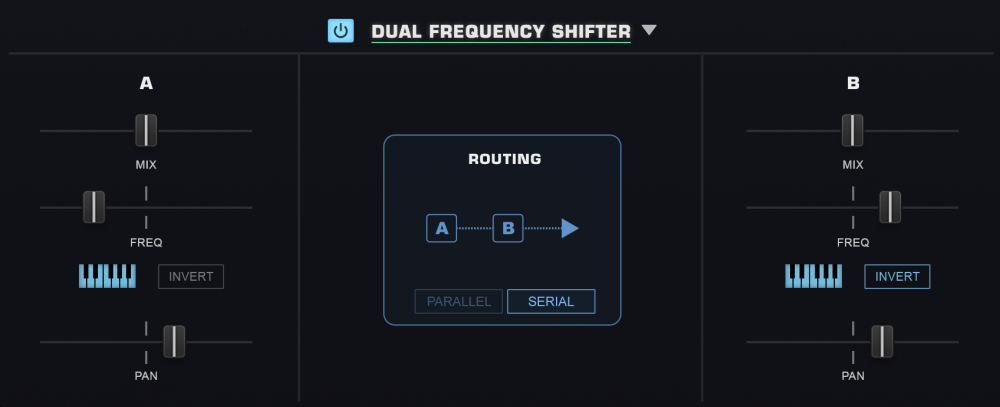
The Dual Frequency Shifter is a highly specialized module, modeled after the analog frequency shifting circuit designed in the 1960s by the German engineer, Harald Bode.
What is a Frequency Shifter?
Every sound is comprised of a fundamental frequency and overtones, often called harmonics or partials. The balance of these overtones is what gives a sound its overall characteristic tone. For example, if the fundamental frequency is 50 Hz, the frequencies of the first three higher harmonics in the harmonic series are 100 Hz (2nd harmonic), 150 Hz (3rd harmonic), 200 Hz (4th harmonic).
A frequency shifter offsets the frequency of each partial in the input by an equal amount up or down in the spectrum, thereby changing the original frequency RATIOS between the partials, altering the harmonic relations. This causes the partials to beat against the fundamental frequency in different ways. The results range from a slightly out-of-tune inharmonicity, creating a slow, vibrato-like, musical modulation (smaller shifts give you more musical results), to sounds that are increasingly atonal and non-pitched.
Each Layer in Omnisphere has a DUAL FREQUENCY SHIFTER, which features two frequency shifters that can be routed in parallel or in series (A feeding into B). Each frequency shifter is modulatable and polyphonic, meaning that each note can have its own shift frequency, mix, and pan.
Dual Frequency Shifter Parameters

The Dual Frequency Shifter is accessed from the FREQ SHIFT button in the center of the Layer Pages or from the tabs along the top of any of the Oscillator Zooms, and is activated from the Power Switch inside the Dual Frequency Shifter Zoom.
Routing
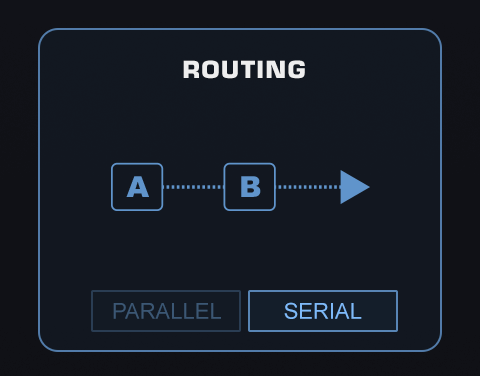
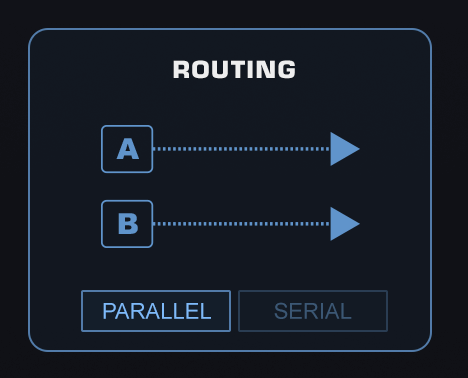
The shifters can be used in Parallel or Serial—A feeding into B.
A/B MIX


Each frequency shifter has a MIX slider that mixes the input signal with the frequency-shifted results.
A/B Frequency

This parameter determines the fixed frequency that is added to each of the partials in the input signal.
For example, if the audio signal has a fundamental frequency of 440Hz with partials at 880Hz and 1760 Hz, and the FREQ slider is set to -200 Hz, then -200 Hz is added to those partials. As a result, the frequencies become 240Hz, 680Hz, and 1560Hz. This causes the ratios between the partials to change, altering the spectrum of the input signal.
If the FREQ slider is in the middle, it has no effect since it adds 0 Hz to the partials. The FREQ curves are exponential—the fader presents higher resolution near the center and moves through the settings faster when nearer the far left or right.
NOTE: You can use the Dual frequency Shifter as a SINGLE shifting effect by selecting PARALLEL and setting the FREQ slider to the middle position for either A or B.
KEY TRACKING

The small keyboard switch enables or disables Key Tracking. The TRACKING button is a dedicated modulation control that determines whether the amount of frequency shifting tracks the keyboard or not.
When KEY TRACKING is OFF, the FREQ slider displays the frequency (in Hz) that is added or subtracted to all partials of the input signal.
When KEY TRACKING is ON, the FREQ slider is scaled to be appropriate for the primary MIDI note being played.
For example, if the primary note being played has a frequency of 440 Hz, then the full range of the FREQ slider ranges from 0 Hz to 880 Hz. This is displayed as 0% to 100%.

INVERT

The INVERT switch reverses the direction of the FREQ slider. When INVERT is ON, the button is highlighted in blue.
PAN

PAN moves the dry and shifted partials left or right in the stereo field.
NOTE: In Serial mode, when PAN is applied to A and B separately, A’s pan is applied before it is fed to B.
PRESETS

Selecting the menu arrow in the section header will display a drop-down menu with a list of factory Dual Frequency Shifter presets, letting you copy, paste, and save your own.
EXAMPLE PATCHES
Explore the following Patches to check out the Dual Frequency Shifter in action:
- C-Beams Glitter in the Dark
- Lure Of The Dark
- Practical Mathematics
- Curious Realms
- Ell o’clock
- Unvarnished Truth Cello
- Wheel Warper
- Splashing Stars
- OSMOSE MPE – Dual Freq Shifter (MPE)
Need more help with this?
Spectrasonics Customer Support